
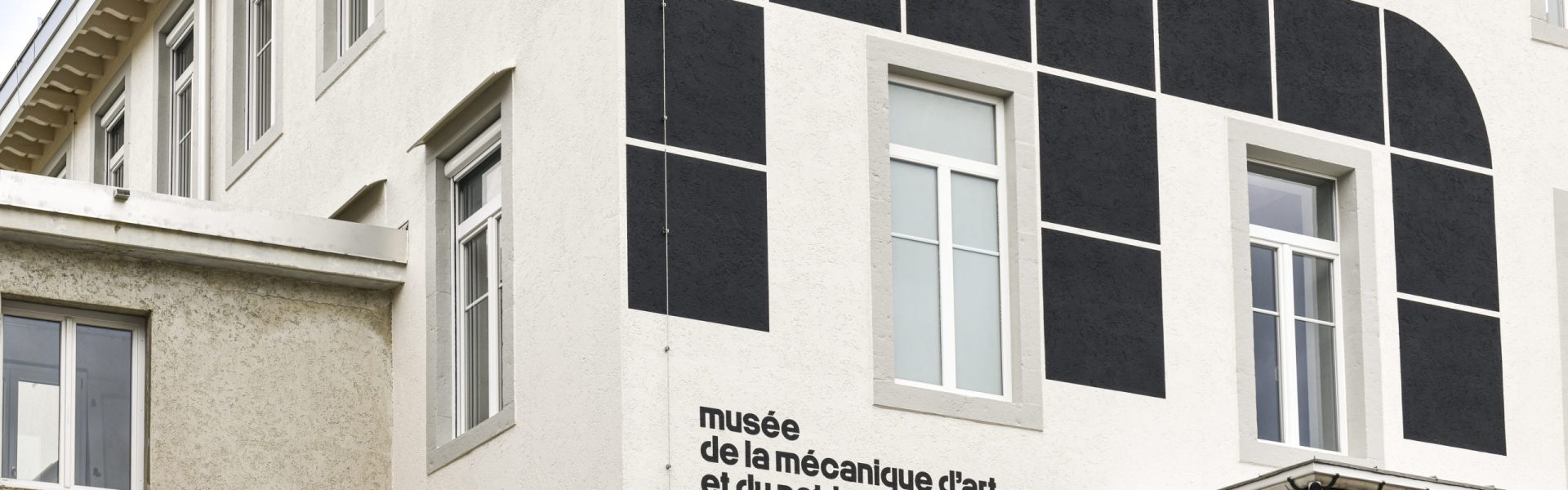
The result of the merger of the Musée des Arts et Sciences (MAS), the Musée Baud and the Centre International de la Mécanique d’Art (CIMA), the MuMAPS takes you on a journey of discovery through mechanical art and regional heritage: from music boxes to automata, from typewriters to Bolex cameras, the history and ingenuity of generations of Sainte-Crix people are revealed in a place where mechanical creativity comes to life.
In 1872, the Société du Musée de Sainte-Croix was founded on the initiative of two science teachers from the Collège Industriel de Sainte-Croix: Gustave Leresche and Henri Schüssler. They formed the core of the collection around three themes: stuffing, mineralogy-geology-botany and antiquities. Like most of Switzerland’s early museum institutions, the Musée de Sainte-Croix reflected its era, characterized by scientific emulation and the beginnings of popularization.
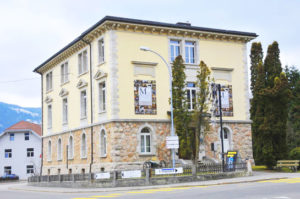
Until 1908, the Society had no premises in which to display its objects, which were then kept in various locations in the village, notably in the attic of the fire pump building in the Rue Neuve. Eventually, a purpose-built museum and library building was inaugurated on Avenue des Alpes. Inspired by the Heimatstil style, it was designed by the Lausanne architects Jules-H. and Henri Verrey.
Although the Musée de Sainte-Croix survived the turmoil of the first half of the 20th century, it nevertheless became obsolete. The Society experienced several difficult years, despite initiatives to modernize the institution: the introduction of temporary exhibitions, membership of the Association des intérêts de Sainte-Croix (1965), and the change of name to “Musée des arts et des sciences” (1985). From 1988 to 1994, the museum closed for lack of visitors. The Society’s members then became involved in temporary exhibitions designed in conjunction with CIMA.
In 1995, the Museum Association set about reopening the museum. A new museography for the permanent rooms was put in place, recreating an “old-fashioned” atmosphere thanks in particular to display cases donated by the Musée cantonal de zoologie de Lausanne. Reopened in November 2000, the institution offered a three-floor tour:
The Musée des arts et des sciences housed almost 9,000 objects and documents illustrating a variety of fields, including archaeology, fine arts, local history, ethnography and the natural sciences. The Society, which later became an association, has always been run solely by volunteers.
As part of the merger of the museums of Sainte-Croix, the Musée des arts et des sciences closed its doors to the public in the spring of 2022. The Association was dissolved in April 2023.
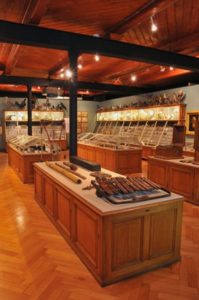
The history of the Musée Baud was intrinsically linked to that of the family of the same name, living in L’Auberson. Three brothers, Frédéric (1915-1998) aka Frédy, Robert (1917-2010) and Auguste (1924-1973), carried on their father’s tradition of making music boxes and farming. In 1946, their association gave birth to the Baud Frères company, which produced and repaired mechanical music boxes. Little by little, the restoration, purchase and sale of these musical pieces became the main activity of the siblings, who received pieces from all over the world.
In 1953, Frédy Baud met Professor Alfred Chapuis (1880-1958), who was preparing a book entitled “Histoire de la boîte à musique” to accompany the “Montres et Bijoux” exhibition at the Musée d’art et d’histoire de Genève. Frédy was invited to participate in writing the technical parts of the book, and then to present mechanical instruments in Geneva. To do this, the Bauds had to restore numerous pieces. After the exhibition, and in view of the enthusiastic response from the public, they finally decided to found a museum dedicated to blade music, mechanical instruments and other automata. This institution was one of the first of its kind in the world. Housed in the Baud brothers’ barn in L’Auberson, it quickly became a great success.
The collection consisted of music boxes, automata, station music, animated pictures, orchestrions, barrel organs and more. The collection was displayed in a room open to the public only under the guidance of a guide who demonstrated the various objects.
The attraction of these pieces led to numerous loans for exhibitions and events in Switzerland and abroad, including the Shopping Centre in Spreitenbach (Aargau), the Hôtel de Ville in Lausanne, the Swiss National Museum in Zurich, the Lyon Organ Festival, the Porte de la Suisse in Paris, and the Hankyu store in Japan.
In 1973, the Baud brothers decided to split their activities. Henceforth, the Baud Frères SA company would devote itself solely to the manufacture, purchase and sale of tuning forks, as well as operating a bar turning and small mechanical workshop. The other company, Musée Baud SA, was to manage the museum.
This split did not, however, facilitate the running of the museum, which since its creation had been managed solely by the Baud family. Despite the commitment of Arlette Baud, daughter of Frédy, and Michel Bourgoz, son of Madeleine Baud (1914-?), the eldest sister of the siblings, the question of a successor to the family was problematic. Thanks to cantonal support in 1995, however, the museum’s future was assured for a good twenty years, and in 2000, it even added a second exhibition room devoted to organs and orchestrions.
In 2010, Arlette Baud and Michel Bourgoz joined forces to consider merging the three museums of Sainte-Croix – L’Auberson. This led to a fundraising campaign to purchase the Baud collection. The success of this operation in 2019 was the first decisive step towards the creation of a single museum on Sainte-Croix. Now governed by CIMA, the Musée Baud will remain open until the end of 2023.
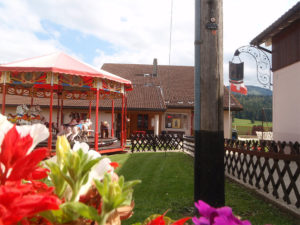
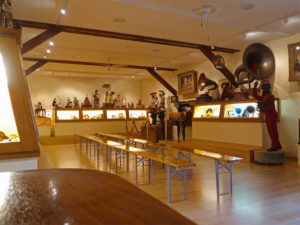
The creation of CIMA came at a particularly difficult economic time for the town of Sainte-Croix. The closure of two major companies, Thorens and Paillard, at the end of the 20th century had resulted in several hundred people becoming unemployed.
In the 1970s and 1980s, the economic climate did not improve. Nevertheless, a strong interest in the fields of music boxes, clocks and automata encouraged a group of enthusiasts to found a Center of Competence aimed at preserving local heritage and revitalizing know-how through mandates or the installation of companies. To give a framework to this objective, a new name was coined: art mechanics, which now encompasses all the principles, techniques and know-how involved in creating a work of art with a mechanical movement.
Governed by a Foundation, the institution moved into the former buildings of Hermes Precisa International. Here, several thousand objects were brought together, donated or loaned by numerous enthusiasts of Sainte-Croix’s craft and industrial history.
CIMA offered temporary exhibitions and, above all, guided tours with demonstrations.
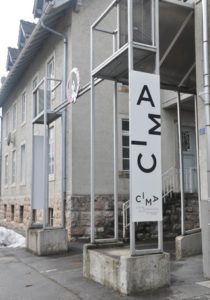
MuMAPS is housed in a historic building built in 1900 by the Paillard company.
Founded in 1814 in Sainte-Croix, the company started out manufacturing music boxes, before moving on to phonographs. In the early 20th century, it expanded its production to include radios, Bolex cameras and projectors, and Hermès typewriters.
Until 1970, the MuMAPS building was the heart of the Hermes Precisa International (HPI) typewriter factory. Between 1985 and 2002, it housed the Centre international de la mécanique d’art (CIMA).
Diane Esselborn
director
Rachel Gueissaz
accounting manager
Philippe Kohler
janitor
Elisabeth Gudit
guide FR
Claude-Alain Habegger
guide FR
Lisa Jakob
guide FR/ANG
Pascale Jaques
reception assistant, guide FR
Alain Jeanmonod
guide FR
Pauline Mayland
Guide FR
Florence Persoz
receptionist
Marianne Sterchi
guide FR/ANG
Benno Sturm
guide ALL
Elisabeth Wendelspiess
guide ALL